 The 2015 Transition Network International Conference will be held in Newton Abbot on 18th to 20th September 2015.
For more information see This write up

The 2015 Transition Network International Conference will be held in Newton Abbot on 18th to 20th September 2015.
For more information see This write up
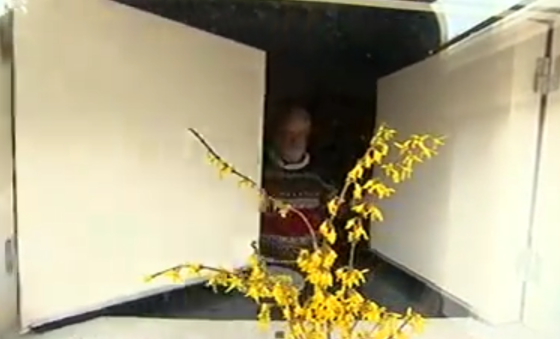 A short video from BBC Midlands Today on how one of our members has renovated his home to make it 90% less carbon intensive. This makes his house one of the most efficient for energy use in the UK.
Our Annual Network Meeting will be held on Monday 13th July 2015 at 7.45 pm at the Malvern Cube, Albert Road North, WR14 2YF. Here is the agenda.
Here is a report(pdf) on the Bonn climate negotiations that took place in June 2015. These negotiations were part of the run up to the major United Nations Climate Change Conference to be held in Paris end the end of the year.
This is a report by Laurie Michaelis a Quaker Environmental delegate. This was passed on to us by the Malvern Quakers.
The developing gleaning network in Worcestershire is looking for someone willing to act as the County Gleaning Coordinator for the forthcoming season (July - November). The post, which is voluntary, would require from 0.5 days to 2 days per week. It would involve contacting farmers and growers to explain the concept, practicalities and aims of gleaning, along with the benefits and considerations for the farmer. The coordinator would encourage volunteers to sign up to the Worcestershire gleaning network and would organise a number of gleaning days in the next few months.
The coordinator would be supported by a steering group from Growing Worcestershire, Gleaning Network UK and a number of local Gleaning Coordinators.
If you or someone you know would like to find out more about what would be involved in taking on this role, please contact John Rhymer (john.rhymer50@gmail.com or ring 01299 403424)
Please pass on this request to others who you think might consider helping us get started with the Worcestershire Gleaning network.
They would also like to find some District Gleaning Coordinators to build local networks of volunteers, identify farmers and growers who might potentially allow gleaning and support the County Coordinator in organising Gleaning Days.
In the next few weeks it should be possible for Worcestershire volunteers to register on the Gleaning Network UK website.
 Members of Transition Malvern Hills attended the Day of Climate Action, a lobby of MPs.
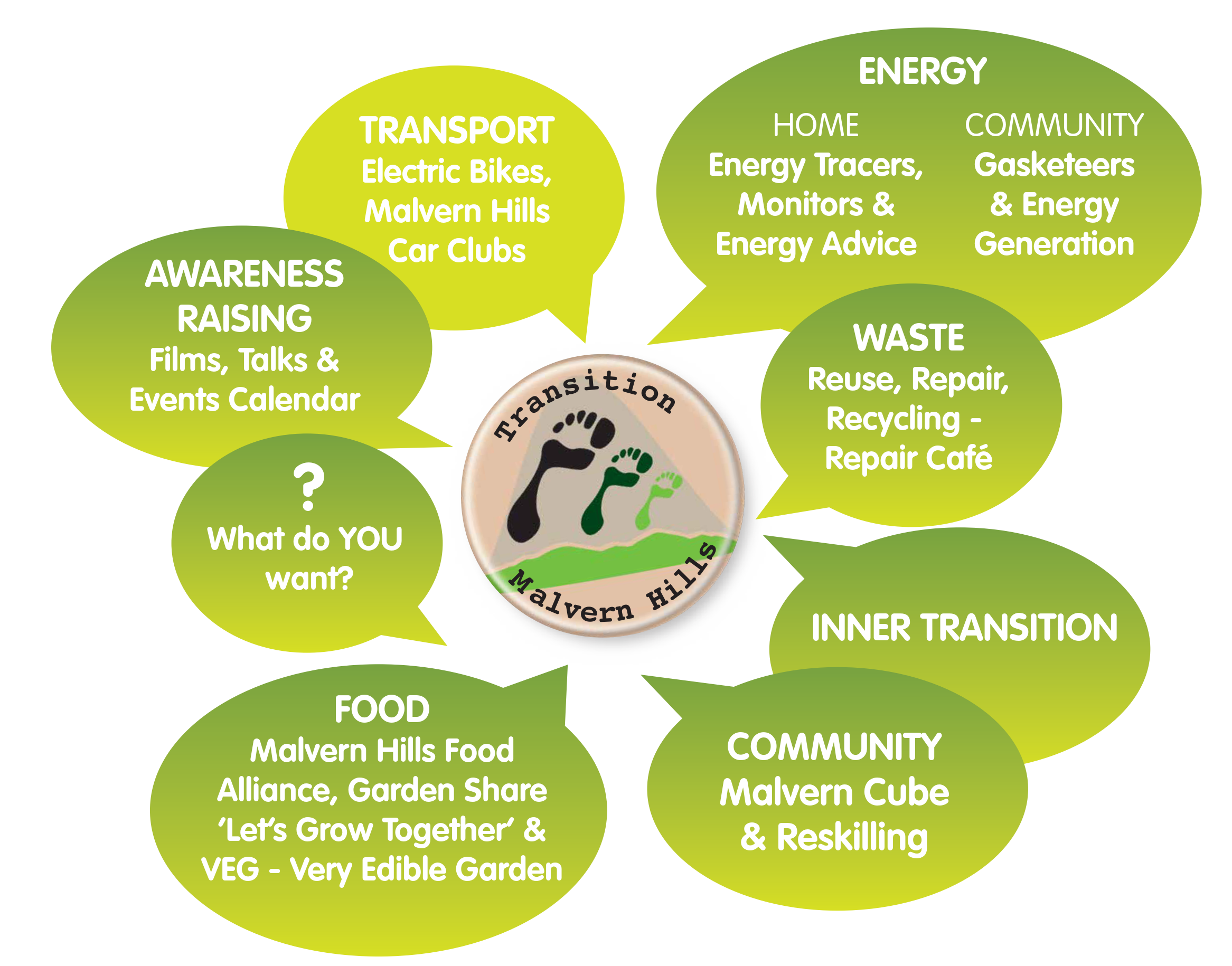
Robin Coates's presentation was a summary of what transition Malvern Hills has done to achieve tackling climate change and building a sustainable community.
Click here to download an edited version of Robin's Presentation (pdf) to the Chance 4 Change event on 16th May at the Cube.

Click here to download Will's Presentation (pdf 7 MB) to the Chance 4 Change event on 16th May.
As part of his talk he gave the Climate Outreach and Information Network (COIN)'s “Walking the Walk” training session. Click here to download COIN's Walking the Walk training guide.
The original low energy light bulbs are compact fluorescent lamps (CFL). These are four times as efficient as the incandescent light bulbs they replaced. They have several problems:

They can take time to switch on and minutes to get to full power.
Over time they get less bright, especially when just turned on. This together with, I think, over optimistic labelling of the wattage of the incandescent they replaced has made us think they are not a good as incandescent light bulbs.
They contain Mercury.
New low energy light bulb are now available, LED bulbs. LED stands for light-emitting diode. These are now available as standard bayonet (B22) lamps for about £7 in local shops and on line. LED bulbs have the following advantages over CFL lamps.
They are even more efficient the CFL, using at least 30% less power for the same brightness.

They are instant on. They do not need time to warm up.
The do not contain Mercury.
They should last 3 times longer than CFL lamps and 25 times that of a standard incandescent bulb. Like CFL LED may get less bright over time but at least 3 times slower than CFL.
How is the brightness of a lamp measured? In the old days when we only had incandescent light bulbs they we measured by the power(electricity) they consumed in Watts(W). This was OK when there were only one type of bulb, and for incandescent it was a good enough measure. When CFL came along they were described by the wattage of the incandescent equivalent. In my view some what optimistically. Now LEDs and other bulbs have come along and we are stopping using incandescent equivalent as this has got ridiculous, so now bulbs are described by how bright they are, this is measured in Lumen. They still also state the power in Watts they use. So the efficiency of a bulb can be measured by lumens/watts.
The standard B22 LED bulbs that are common now come in two brightnesses 450+ and 800+ lumens. These are equivalent of the old incandescent 40w and 60w, I think now pessimistically rated. I tried an 810 lumen LED light in my landing and it was too bright.
I am not sure there is an argument for replacing existing CFL with LEDs ahead of when you would replace the CFL. But due to the longer life and less electricity consumed by LED bulbs, for both economic and environmental reasons we should stop buying any more CFL bulbs and buy LED bulbs. And LEDs are better bulbs.
Above I was talking about standard bayonet bulbs, but the most inefficient in our houses these days are normally halogen bulbs. These are another form of incandescent light bulbs they are found in GU10 spot lights, normally in kitchens and bathrooms.

LED GU10 have been available for a few years and given that LED are more directional than halogen they only need about 1/8 the electricity to produce the same effective light. Some of the early LED GU10 were a bit dim. But any current LED GU10 over 400 lumen (5W) should be a good replacement for 50W incandescent. Given that LEDs last at last 10 times longer than halogen the conclusion is again only buy LED bulbs, but with halogen there may be an economic and environmental argument to replace existing bulbs with LED.
Another reason to replace all halogen with LEDs is that a lot of them are on when the electricity demand is at it's highest, 6pm on a winter's evening, and the reduction in peak grid demand would save building at least one new power station.
Halogen bulbs are also found in outside flood lights and these can be replaced by LEDs.
Not all LED can be used with dimmers but ones that can are available sometimes at a slight extra cost.
LED bulbs can come in different colours warm white or bright white. And if you pay more any colour you like and some even changeable by remote control.
This article first appeared in our March to June 2015 Newsletter and on iccaldwell.com
 If you've ever wondered how to compare parties on their environmental policies, here are some ideas on question to ask.
What importance does the party give to environmental issues?
Are any steps being taken to encourage the thrifty use of finite resources?
Is endless growth the only way run an economy?
In what ways are you looking at land use to ensure support for local farming and a sustainable food supply?
How will your party significantly reduce the amount of waste produced through encouraging waste reduction at source?
How will your party reduce society’s dependency on oil?
How can less energy be used?
How will the production of renewable energy be encouraged?
(NB oil and gas are cheap now, but the market is volatile)
How would you run the Green Deal to make it easier to understand?
What policies does your party have improve transport infrastructure and to integrate public transport?
How do tax breaks/subsidies for renewable energy production compare with breaks/subsidies for fracking/conventional energy?
As a high percentage of the UK’s current housing stock is ageing and poorly insulated, would your party introduce a nationwide affordable home insulation programme help reduce fuel poverty?
To what extent does your party recognise rural poverty and how does it perceive its policies may have different impacts town and in the countryside?
(eg bus passes, fuel duty, cavity insulation)
Party websites, publications, meetings, canvassers… Good luck!
This article first appeared in our March to June 2015 Newsletter